


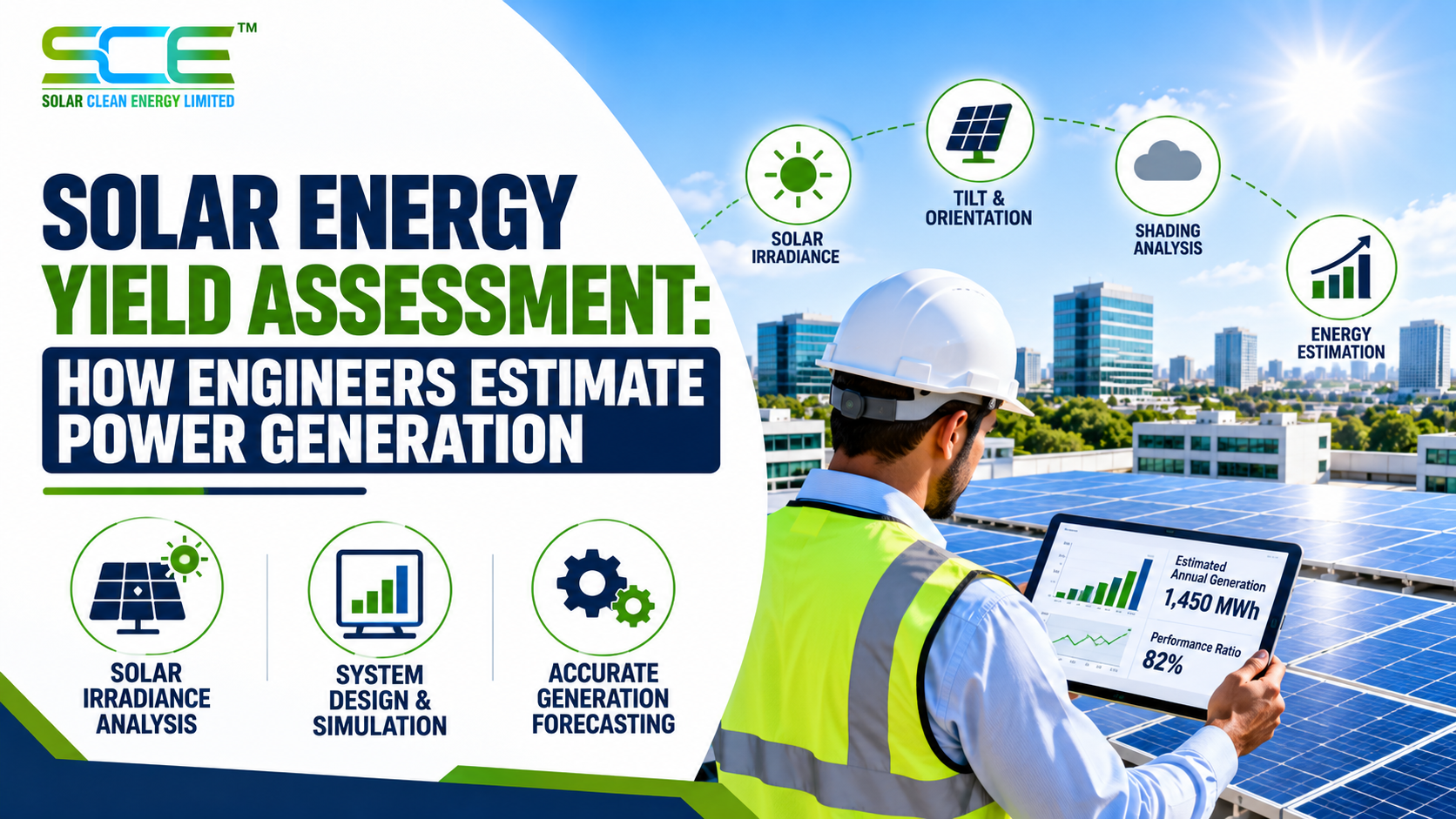
Solar power generation depends on more than the number of solar panels installed. Sunlight availability, system design, panel orientation, shading, equipment efficiency and environmental conditions all influence how much electricity a solar power plant can produce.
A solar energy yield assessment helps engineers estimate the expected electricity generation of a solar Photovoltaic (PV) system before installation. It supports project planning, technical design, financial evaluation and performance forecasting for residential, commercial, industrial and utility-scale solar projects.
In this guide, we explain how engineers assess solar energy yield, which factors influence power generation and why accurate estimation matters for successful solar projects.
What Is Solar Energy Yield Assessment?
Solar energy yield assessment is the process of estimating the amount of electricity a solar PV system can generate over a specific period, such as a day, month or year.
Engineers evaluate solar radiation data, geographical location, system capacity, module characteristics, inverter performance, installation conditions and expected system losses to calculate projected energy production.
The results are generally expressed in kilowatt-hours (kWh) or megawatt-hours (MWh). For example, a commercial solar plant may have its expected annual electricity generation estimated during the feasibility and engineering stages.
Key Factors That Affect Solar Energy Yield
Solar Irradiance and Weather Conditions
Solar irradiance refers to the amount of solar power received per unit area. It is one of the most important inputs in estimating solar electricity generation.
Engineers analyze historical solar radiation data, local weather patterns and seasonal variations to understand the site’s energy potential. Cloud cover, rainfall, dust and atmospheric conditions can influence the available sunlight.
In India, solar irradiance varies by region and season, so using location-specific data is essential for reliable predictions.
Geographic Location and Site Conditions
The project’s location affects sunlight availability, ambient temperature and weather conditions. Engineers evaluate the site’s latitude, longitude, elevation and surrounding environment during the assessment.
A detailed site assessment also identifies nearby buildings, trees, structures and other obstacles that could create shadows on solar modules.
Solar Panel Orientation and Tilt Angle
The direction and tilt of solar panels affect how much sunlight reaches their surfaces throughout the year.
Engineers assess the appropriate orientation and tilt based on geographical location, available land or rooftop space, structural limitations and project requirements. In India, panels generally face south for fixed-tilt installations in many locations, but the optimal configuration depends on the site’s specific conditions and objectives.
For more information, explore our PV Design and Layout Services.
Why Is Solar Energy Yield Assessment Important?
Improves Project Planning
Estimating expected electricity generation helps determine the appropriate solar plant capacity based on the site’s energy requirements, available space and installation conditions.
Supports Financial Feasibility
Projected energy production helps businesses estimate electricity bill savings, potential revenue and the payback period. These estimates depend on applicable tariffs, project costs, financing and operating conditions.
Helps Optimize System Design
Identifies Potential Energy Losses
Assessments consider shading, temperature, wiring losses, inverter efficiency and other factors that may reduce actual electricity generation.
Establishes Performance Expectations
The estimated energy yield provides a baseline for comparing actual plant performance after commissioning, while accounting for weather variability and differences between predicted and actual operating conditions.
How Engineers Calculate Solar Energy Yield
Step 1: Collect Site and Solar Radiation Data
Engineers gather geographical information, historical weather data, solar irradiance records and site measurements. They may use satellite-derived datasets, meteorological databases and on-site measurements where available.
The quality and suitability of the input data directly affect the reliability of the assessment.
Step 2: Determine the Solar Plant Capacity
Engineers gather geographical information, historical weather data, solar irradiance records and site measurements. They may use satellite-derived datasets, meteorological databases and on-site measurements where available.
The quality and suitability of the input data directly affect the reliability of the assessment.
Step 3: Analyze the System Design
Engineers gather geographical information, historical weather data, solar irradiance records and site measurements. They may use satellite-derived datasets, meteorological databases and on-site measurements where available.
The quality and suitability of the input data directly affect the reliability of the assessment.
Step 4: Estimate Energy Generation
Daily energy generation = Installed capacity × Peak sun hours × Performance ratio
For example, consider a hypothetical solar PV system with the following assumptions
|
Parameter
|
Assumed value
|
|---|---|
|
Installed capacity
|
100 kWp
|
|
Peak sun hours
|
5 hours/day
|
|
Performance ratio
|
80%
|
Calculation:
100 kWp × 5 hours × 0.80 = 400 kWh per day
Solar Energy Yield Assessment for Commercial and Industrial Projects
For commercial and industrial businesses, energy yield assessment is an important part of evaluating a solar investment.
Engineers consider the site’s electricity consumption, available rooftop or ground area, operating schedule, grid connection requirements and proposed system capacity. They also evaluate how solar generation aligns with the facility’s energy demand.
A well-planned assessment can help businesses:
Estimate potential electricity production.
Evaluate solar capacity against energy consumption.
Compare alternative system designs.
Understand potential electricity bill savings.
Support technical and financial feasibility studies.
Establish realistic performance expectations.
Solar Clean Energy provides solar engineering and EPC-related services to support solar project planning and execution. Learn more about our Solar Engineering Services and Solar EPC Solutions.
Common Mistakes to Avoid During Solar Energy Yield Assessment
Using generic sunlight data: Use data appropriate to the project’s location and assessment period.
Ignoring shading: Evaluate obstructions and inter-row shading before finalizing the layout.
Underestimating system losses: Include relevant temperature, inverter, cable, soiling and downtime losses.
Relying only on annual averages: Review monthly or hourly generation patterns where appropriate.
Overlooking equipment specifications: Use accurate module, inverter and system configuration data.
Treating estimates as guarantees: Account for uncertainty, weather variability, degradation and operating conditions.
Frequently Asked Questions (FAQs)
Solar energy yield assessment estimates the electricity a solar PV system can generate over a defined period using solar radiation data, system specifications, site conditions and expected losses.
Engineers analyze solar irradiance, installed capacity, panel orientation, temperature, inverter performance and system losses. They may use PV simulation software to estimate daily, monthly and annual generation.
The performance ratio measures how effectively a solar PV system converts the available solar resource into electricity compared with its reference output, accounting for relevant system losses.
Yes. Engineers can estimate energy generation before installation using historical solar resource data, site assessments, proposed equipment specifications and system simulation.
Common factors include shading, high module temperatures, dust accumulation, inverter and cable losses, module degradation, equipment downtime and unfavorable weather conditions.
Conclusion
Solar energy yield assessment is a critical step in planning an efficient and financially viable solar power project. By analyzing solar irradiance, site conditions, system capacity, module performance, inverter configuration and expected losses, engineers can estimate electricity generation more accurately.
For commercial, industrial and utility-scale projects, a detailed assessment supports system design, feasibility analysis and realistic performance planning. Combining reliable solar resource data with sound engineering practices helps project owners understand the expected output and make informed investment decisions.
Planning a solar power project? Visit Solar Clean Energy to learn about our solar engineering, feasibility, PV design and EPC services.