


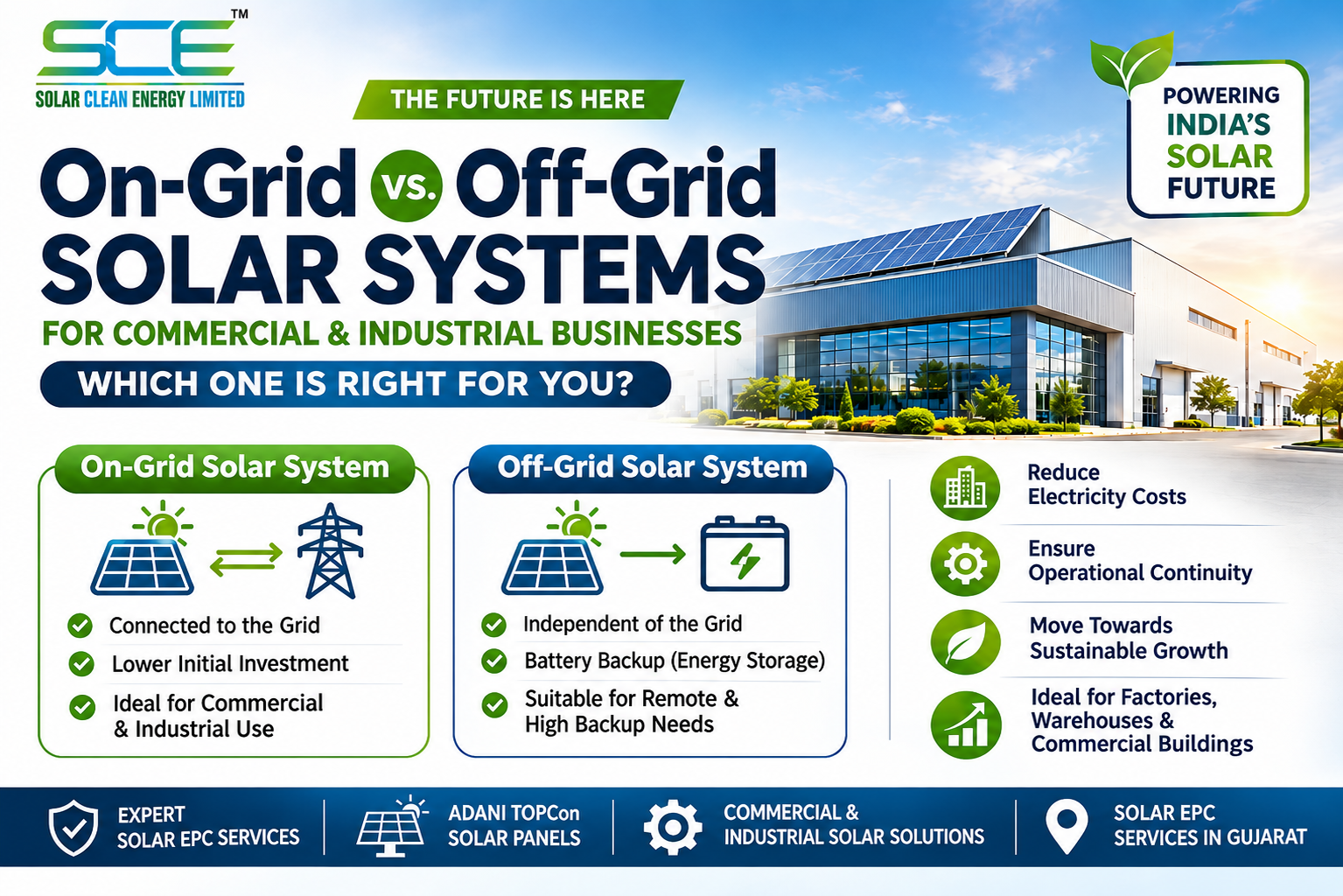
As electricity consumption continues to increase across industries and commercial establishments, businesses are looking for reliable ways to reduce energy expenses and improve operational efficiency. Solar energy has become an effective solution for factories, warehouses, hospitals, hotels, offices and other commercial facilities.
However, before investing in solar energy, one important decision is choosing the right system configuration. The two commonly considered options are on-grid and off-grid solar systems.
Understanding the difference between on-grid and off-grid solar systems helps businesses select a solution based on electricity consumption, grid availability, backup requirements, available installation space and investment budget.
What Is an On-Grid Solar System?
An on-grid solar system, also known as a grid-connected solar system, is connected to the electricity distribution network. It generates electricity through solar panels and supplies the generated power to the building or industrial facility.
During daylight hours, solar panels convert sunlight into DC electricity. A solar inverter converts this electricity into AC power, which can be used by electrical equipment, machinery, lighting and other business operations.
When solar generation exceeds the building’s consumption, surplus electricity may be exported to the electricity grid, subject to applicable regulations and DISCOM approvals.
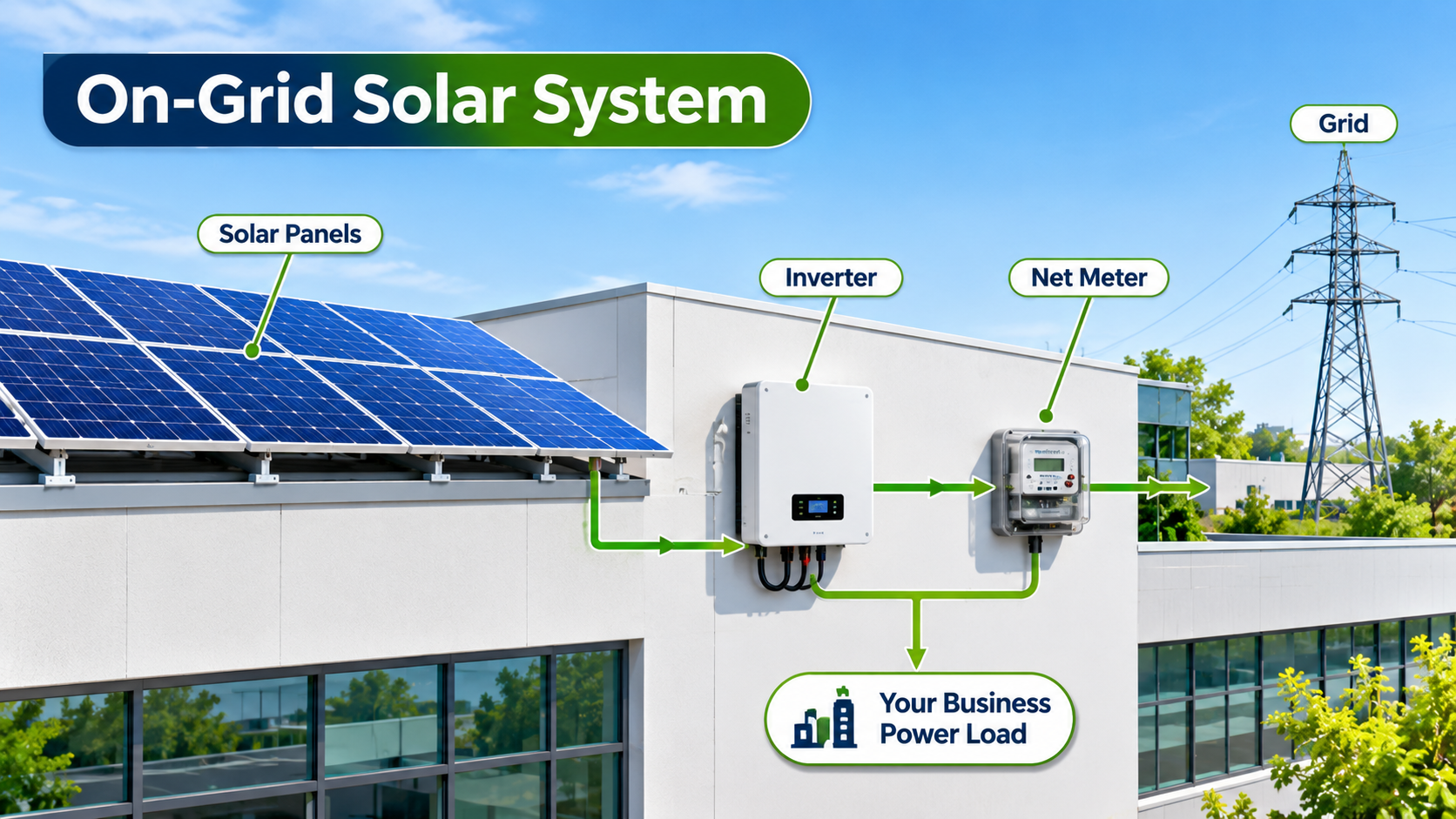
How Does an On-Grid Solar System Work?
- Solar Panels: Capture sunlight and generate DC electricity.
- Solar Inverter: Converts DC electricity into usable AC electricity.
- Electrical Protection System: Helps protect the installation against electrical faults.
- Net Meter or Applicable Metering Arrangement: Measures electricity imported from and exported to the grid, according to the approved arrangement.
- Electricity Grid: Supplies additional electricity whenever solar generation is insufficient.
Advantages of On-Grid Solar Systems for Businesses
Lower Initial Investment
On-grid solar systems generally have a lower initial investment than comparable off-grid systems because they do not require large battery storage installations.
Reduced Electricity Expenses
Businesses can use solar-generated electricity to offset their daytime consumption and reduce the amount of electricity purchased from the grid.
No Large Battery Storage Requirement
Since the electricity grid supports the system when solar generation is insufficient, large battery banks are generally unnecessary.
Suitable for Commercial and Industrial Facilities
Factories, offices, warehouses, hospitals and shopping centres with reliable grid connectivity can benefit from grid-connected solar installations.
Easier Energy Management
Businesses can monitor solar generation and electricity consumption to understand system performance and manage their energy requirements.
What Is an Off-Grid Solar System?
An off-grid solar system operates independently of the public electricity grid. It generates electricity through solar panels and stores surplus energy in batteries for use when sunlight is unavailable or insufficient.
Unlike a conventional on-grid system, an off-grid installation is designed to supply electricity without depending on the utility grid.
These systems are particularly useful for remote industrial facilities, rural establishments, agricultural operations and locations where grid connectivity is unavailable or unreliable.
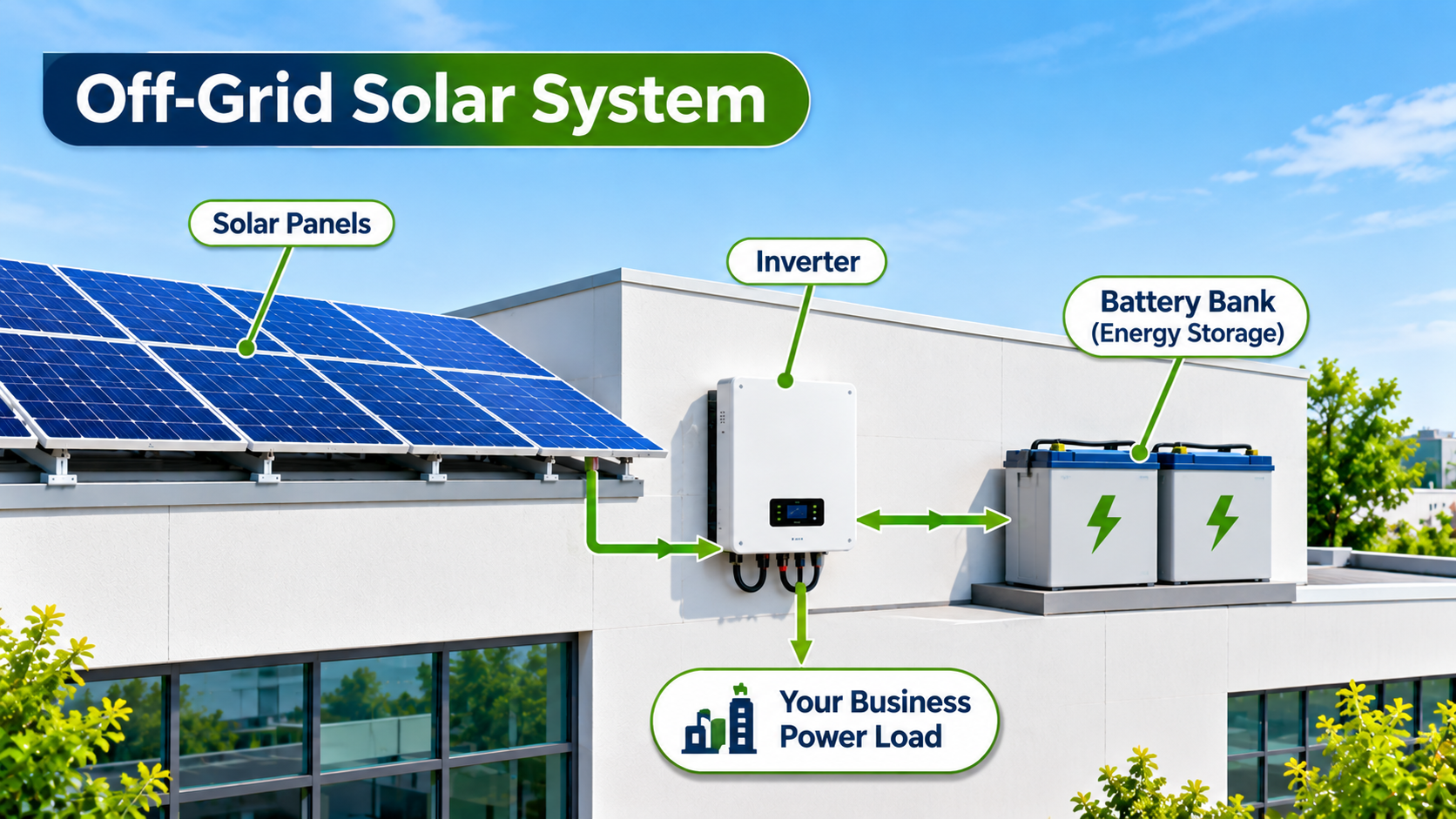
How Does an Off-Grid Solar System Work?
- Solar Panels: Generate electricity using sunlight.
- Solar Charge Controller: Regulates electricity flowing from the panels to the batteries.
- Battery Storage: Stores surplus solar electricity for later consumption.
- Off-Grid Inverter: Converts stored DC electricity into AC electricity for business equipment.
- Backup Generator (Optional): Provides additional electricity during extended periods of insufficient solar generation.
During the day, solar panels generate electricity to operate the connected loads and charge the batteries.
Advantages of Off-Grid Solar Systems for Businesses
Energy Independence
Off-grid systems allow businesses to generate and store electricity without depending on the public electricity grid.
Useful for Remote Locations
Industrial facilities, warehouses and agricultural businesses located in areas with limited grid infrastructure can benefit from off-grid solar power.
Battery-Based Backup
Stored solar electricity can supply connected loads when solar panels are not generating sufficient electricity.
Flexible Installation Locations
Off-grid systems can be installed in locations where establishing a conventional grid connection is difficult or expensive.
Improved Energy Availability
A properly designed system with sufficient battery storage and backup provisions can support business operations during periods of limited sunlight.
On-Grid vs Off-Grid Solar Systems: Key Differences
| Comparison Parameter | On-Grid Solar System | Off-Grid Solar System |
|---|---|---|
| Grid Connection | Connected to the electricity grid | Operates independently |
| Battery Requirement | Generally not required | Required |
| Initial Investment | Generally lower | Generally higher |
| Electricity Storage | No dedicated battery storage in a conventional setup | Stores electricity in batteries |
| Power During Grid Outages | Standard systems shut down | Can supply connected loads |
| Maintenance | Generally simpler | Includes battery maintenance |
| Energy Independence | Depends on grid availability | Greater independence from the grid |
| Suitable Locations | Commercial and industrial areas with grid connectivity | Remote areas with limited grid access |
| Main Application | Reducing electricity bills | Independent electricity supply |
| System Design | Grid-connected inverter configuration | Battery-based inverter configuration |
Importance of Choosing the Right Solar EPC Company
Selecting the right Solar EPC partner is an important part of a successful commercial or industrial solar project.
A professional EPC company manages different stages of the project, from initial assessment and engineering to equipment procurement, installation and commissioning.
Our EPC services can include:
Solar project feasibility assessment.
Solar system design and engineering.
Photovoltaic electrical engineering.
Solar panel and inverter selection.
Mounting structure planning.
Equipment procurement.
Installation and commissioning.
Project management.
Operation and maintenance support.
Businesses looking for Solar EPC services in Gujarat should work with an experienced team that understands project requirements, engineering standards and applicable regulatory procedures.
Explore our Solar EPC Services and Solar Engineering Solutions.
Why Adani TOPCon Solar Panels Are Worth Considering for Commercial Projects
Solar panel technology plays an important role in the performance of commercial and industrial solar installations.
Adani Solar offers different solar module technologies, including TOPCon modules, which can be considered for suitable commercial and industrial applications.
TOPCon (Tunnel Oxide Passivated Contact) is an advanced solar cell technology designed to improve cell efficiency and energy generation performance.
When evaluating solar panels for a commercial project, businesses should consider:
- Module efficiency.
- Power output and available module ratings.
- Temperature performance.
- Product and performance warranties.
- DCR or non-DCR requirements, where applicable.
- Project-specific technical specifications.
- Compatibility with the selected inverter and system design.
Solar Clean Energy is an Adani Solar channel partner and supports Adani solar module distribution for EPC companies, dealers, installers and project developers.
If you are searching for an Adani TOPCon Solar Panel Distributor, explore our product information:
Adani TOPCon Solar Panel Distributor in India.
Businesses looking for an Adani Solar Panel Distributor in Ahmedabad or an Adani Solar Panel Distributor in Gujarat can also learn more about our distribution network.
Frequently Asked Questions (FAQs)
An on-grid solar system is connected to the electricity grid and uses grid power when solar generation is insufficient. An off-grid solar system operates independently and uses batteries to store electricity for later consumption.
On-grid solar systems are generally suitable for commercial buildings with reliable grid connectivity and high daytime electricity consumption. The final selection depends on the building’s energy requirements and backup needs.
Yes. Off-grid solar systems can be suitable for remote industrial facilities where grid connectivity is unavailable or unreliable. However, proper battery sizing and backup planning are essential.
A conventional on-grid solar system generally shuts down during a grid outage due to anti-islanding safety requirements. Battery-based hybrid systems with appropriate backup functionality can supply designated loads.
Off-grid solar systems require batteries to store electricity. Hybrid solar systems also use battery storage, while conventional on-grid systems generally operate without batteries.
Conclusion
Choosing between on-grid and off-grid solar systems depends on your business’s electricity consumption, grid connectivity, backup requirements, available installation space and investment budget.
On-grid solar systems are generally suitable for commercial buildings and industries with reliable grid connectivity and significant daytime electricity consumption.
Off-grid solar systems are more appropriate for remote locations where independent electricity generation and battery storage are essential.